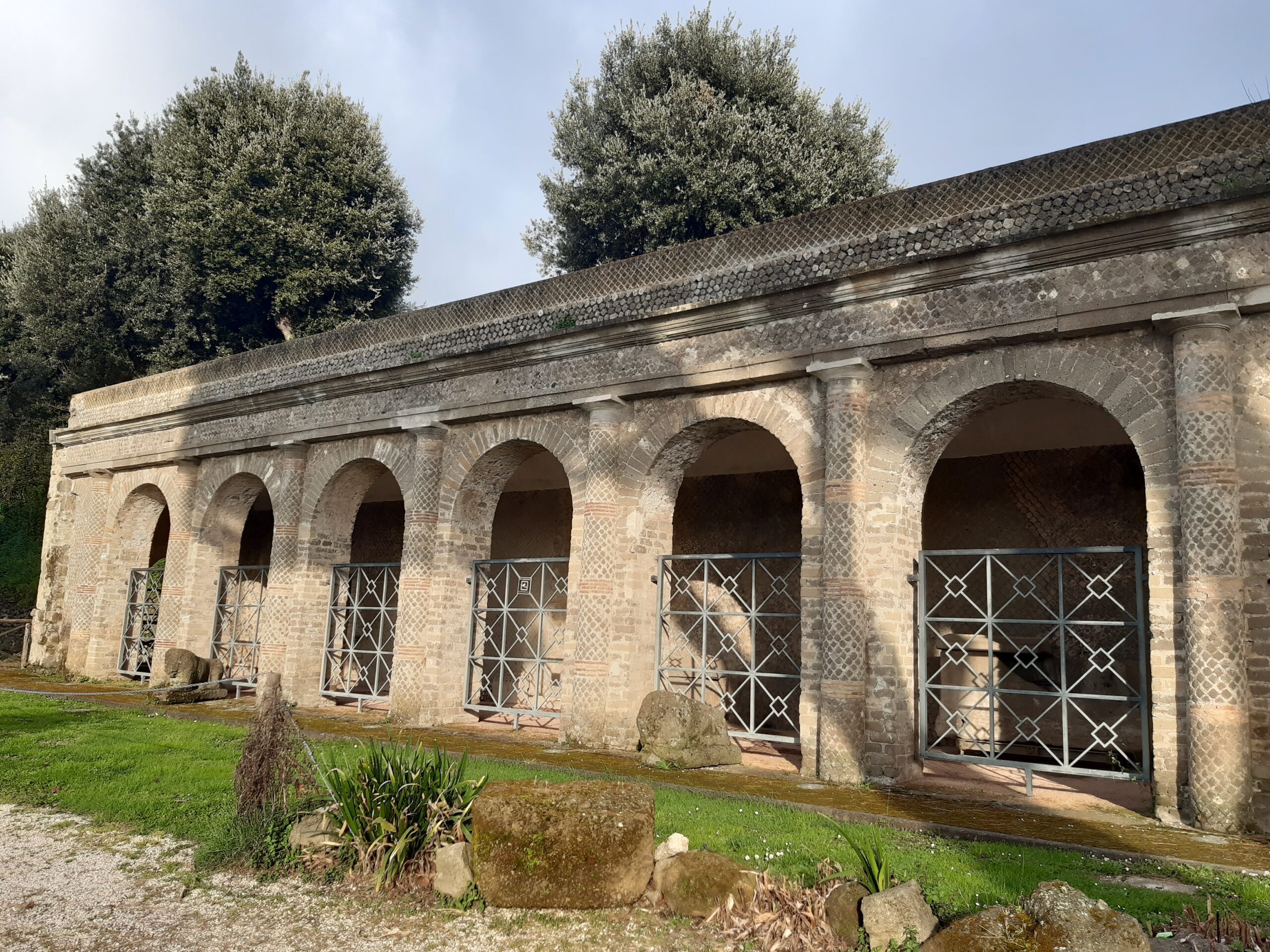
Lanuvio (ancient Lanuvium) is famous for being the birthplace of two Emperors, Antoninus Pius and Commodus (Marcus Aurelius also spent his childhood there), and for its temple of Juno Sospes (the Saviour). One prominent native of Lanuvium was Lucius Licinius Murena (consul, 62 BCE) whom Cicero defended in 63 BCE.
According to Appian of Alexandria (a Greek historian with Roman citizenship who wrote about Roman history and lived during the reigns of Trajan, Hadrian, and Antoninus Pius) Lanuvium was founded by Diomedes, a hero in Greek mythology known for his participation in the Trojan War.
After having fought in the Trojan War, the hero accompanied by his most trusted men left for Italy, where due to a storm he was left stranded on the coasts of Daunia. There he helped king Daunos fight the Messapians, married his daughter and founded several cities, one of which was Lanuvium.
In the version we find in Quintus Fabius Pictor (the earliest known Roman historian) the founder of Lanuvium (whose Greek name is Lanoion) was Aeneas’ companion Lanoios, who was from Centuripe (in present-day Sicily).
The most ancient findings in Lanuvio date back to the protohistoric period (11th-10th century BCE), while the rapid expansion of the town in the pre-Roman era is mainly due to the local cult of Iuno Sospes Mater Regina, a cult that attracted the nearby Latin peoples.


According to Cicero, Lanuvium was among the cities that towards the end of the V century BCE, joined the Latin League against Rome and fought at the Battle of Lake Regillus in 496 BCE, in which Rome was victorious. Lanuvium was conquered by Rome in 338 BCE and was granted civitas cum suffragio in exchange for administering the proceeds of the temple of Juno Sospes.
A Roman bridge, the so-called Ponte Loreto (2nd-1st century BCE) and a Roman road, the Via Astura, are still visible today (signposting for Ponte Loreto is very good from the city centre, so it is relatively easy to get there). The ancient Via Astura connected Antium to Satricum and Lanuvium.


In 2012 a sensational discovery was made in Pantanacci, in the Ager lanuvinus (not far from the Sanctuary of Juno Sospes): a votive deposit in a cave containing thousands of artifacts (4th-2nd century BCE), including pottery (also miniatures), anatomical votive offerings among which a series of oral cavities stand out, and last but not least, four elements in peperino bearing engraved scales, part of a majestic statue depicting a snake. It could be the well-known snake sacred to Juno, to which a specific cult was dedicated.


The end of ancient Lanuvium came about after the Edict of Thessalonica in 380 CE, which made catholicism the state church of the Roman Empire and which forbade all pagan cults and shut down all the pagan temples, including that of Juno Sospes in Lanuvium.
The Benedectine monks are responsible for rebuilding the city and its walls in the 10th century CE on its Roman foundations. Starting from the 11th century four out of the five towers still visible today were added to the castle of Civita Lavinia (the new name of the city).


In 1410 the Colonna family gained control over the city, which was handed over to them by the Church and which they kept until 1564. Marcantonio Colonna, one of the admirals of the Battle of Lepanto, was born in Citiva Lavinia.
In 1564, Marcantonio sold his possessions in Lanuvio to Giuliano Cesarini. Under the Cesarini the town enjoyed a long period of peace and prosperity. The main tower, restored in the 14th century, was converted into a prison.


In 1675 Filippo Cesarini gifted a roman sarcophagus (late III century CE) to the city: it was placed on the façade of Palazzo Colonna and used as a fountain. An inscription is also plastered on the façade and it reads:
T(ito) Aurelio
Aug(usti) L(iberto)
Aphrodisio
Proc(uratori) Aug(usti)
a rationibus
S.P.Q.L.


In the same year, he also commissioned a fountain to architect Carlo Fontana, the so-called Fountain of the Rocks, which also features two snakes carved among the rocks (a reference to the cult of Juno Sospes’ snake).

The Santuario della Madonna delle Grazie includes an early 16th century church which was built on a pre-existing 14th century church. Part of the 16th century cloister and a stretch of a Roman necropolis can be found at the back of the church.


The Chiesa Collegiata di Santa Maria Maggiore (1675) was also commissioned from Carlo Fontana. It was built over an early medieval church of which only a few sculpture fragments survive. Among the artworks inside the church is a painting by Baciccio depicting the Calvary.

The Museo Civico Lanuvino is a little gem and the museum itself is scattered around the city (“Museo Diffuso”) as several locations can be visited, such as the room where the Pantanacci votive offerings are on display (albeit a very small part of them, as thousands of objects have been excavated so far!) but also the archaeological museum, where you can find a section with inscriptions, proto-historic pottery, votive offerings, fragments of frescoes, a beautiful winged griffin from the theatre of ancient Lanuvium (2nd century CE) and much more.


A group of sculptures representing Roman soldiers fighting on horseback, and which may have been based on the bronze group by the Greek sculptor Lysippos, showing Alexander the Great’s victory over the Persians at the battle of the Granikos, has been linked with Lucius Licinius Murena of Lanuvium, who fought with the Roman general Lucullus in the war against Mithradates of Pontus. Part of the group is held at Leeds City Museum and the British Museum, while other fragments are on display at the Museum in Lanuvio (see pictures).


This coming autumn new locations will be opening to visitors, such as Palazzo Colonna and new parts of the Tower, which was also mentioned by French author Stendhal in his novel La Duchesse de Palliano (hence its nickname, “Stendhal’s Tower”). A wonderful view can be enjoyed from atop the tower, you will even be able to see Ischia!
Lanuvio is an absolutely lovely place full of myth, history and culture, make sure you visit this beautiful town when in or around Rome, you won’t be disappointed.
Main source: Luca Attenni, Lanuvio – Guida per il nuovo viaggiatore – I tesori di Lanuvio, Valtrend Editore
Comments are closed