
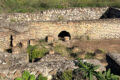
The historic centre of Artena, located in the north-west of the Monti Lepini, is one of the biggest pedestrian areas in Europe. You can either walk to the top of the town or go up on a mule. Artena is a lovely Renaissance town rich in history and culture. The first known settlement is that of a Volscian acropolis dating back to the V century BCE and located at 630 metres above sea level. Also known as Piano della Civita, this fortified town boasts impressive walls built in cyclopean masonry using local limestone.
Your hike to the top of the town will be rewarded by amazing sights such as that of the Church of Santa Croce, originally built by the Counts of Tusculum, which owned Montefortino (Artena’s former name, which it kept until 1873) in the late XI century. Montefortino’s ownership shifted to the Counts of Segni between 1226 and 1475, and finally to the Colonna family.

Other prominent sights in Artena include Palazzo Borghese, originally built in the XIII century by the Counts of Segni, then owned by the previously mentioned Colonna family together with the Massimo family and lastly by Scipione Borghese, who commissioned the palace to be built in its current form in the XVII century.

The Palazzetto del Governatore (Governor’s Palace) is a XVII century palace located in front of Palazzo Borghese and built by Dutch architect Vasanzio (Jan van Santen), who also worked on the previously mentioned Palazzo Borghese and built the Casino Nobile in the park of Villa Borghese, Rome (today’s Galleria Borghese). The palace was used as the governor’s residence and also as a prison.

On the path to the historic centre of Artena, you’ll find the so-called Arco Borghese (Borghese Arch), commissioned by Scipione Borghese and built between 1618 and 1624 by Martino Longhi and Vasanzio.

Last but not least, is the Ex Granaio Borghese (former Borghese granary), a beautiful XVIII century building currently hosting the local Archaeological Museum, dedicated to Roger Lambrechts.
If you think history is all Artena has to offer, you are much mistaken!The city also boasts its very own Rugby Museum (located in a beautiful historical palace, of course!) and was used as a location for a variety of films, including Franco Zeffirelli’s adaptation of Shakespeare’s Romeo and Juliet (the famous balcony scene was filmed in the Palazzo Borghese).

The actress Claudia Cardinale chose to move to Artena after shooting a film there, Il prefetto di ferro (The iron prefect) in 1977.
While in Artena don’t forget to try all the local specialities, you won’t be disappointed!


Comments are closed